

What is a Senior Integrated Project (SIP) in Religion?
The SIP is (usually) an essay dealing in a sustained way with a topic of particular interest to the student and raises broader questions for the study of religion. In selecting a topic students should keep in mind both of these criteria as well as the fact the paper should be an example of what the word essay means: a careful effort to develop and test the writer’s analytical and interpretative powers. The SIP is not to be a small-scale Ph.D. dissertation. An exhaustive command of the topic is not required. Ideally the project should address a significant question having a future, i.e., it is capable of sustaining interest and generating dialogue among scholars over an extended period of time. An effective thesis, however, will address such a question by focusing on a specific, manageable aspect of it. The subject matter of the theses will naturally vary widely, by virtue of the nature of the field of religion. In every case, the subject should be specific enough to allow for depth of treatment. At the same time, however, it should not be so narrowly and technically construed as to allow the writer to lose sight of its relations to broader issues in the study of religion. Students are strongly encouraged to build on projects they have already explored in a junior tutorial or other coursework. The senior thesis is the capstone of the undergraduate curriculum in the Religion, and has the potential to be a significant experience of intellectual and personal growth.
The final SIP in Religion is usually a minimum of 45 pages, and (preferably) no longer than 65 pages, including bibliography and notes. The critical feature of a SIP in Religion is not length, but acuity of insight and keenness of observation. We expect each SIP to go through at least two and more often three drafts. It is expected students be in consultation with their advisors during the writing process, so no surprises will be in store for either the advisors or the students by the time the second draft is completed. The final draft, formatted according to the University of Chicago Manual of Style guidelines, is due on the first day of the term following your write-up quarter. Students should check with advisors by the end of the sixth week to receive their grades.
There are several components to the SIP in Religion.
- Research Prospectus in Junior Seminar, which becomes the formal SIP proposal due Friday, Week Eight in Spring Quarter, Junior year to Junior Seminar instructor.
- Successful completion of deadlines in Fall SIP Workshop in Religion
- Final submission of SIP in Week One of Winter Quarter, Senior year.
Calendar of Deadlines and Events for Religion SIPs
Spring Quarter: Junior Year
Summer Research for Rising Seniors
Fall Quarter: Senior Year
Winter Quarter: Senior Year
Spring Quarter: Junior Year
Junior Seminar in Religion is required of all students who are writing a SIP in Religion. In as much, seminar students will write a research prospectus which must be approved by the department before summer research begins.
The research prospectus will consist of the following components: (1) an introduction; (2) a survey and analysis of the secondary literature on your topic; (3) a methods section; (4) a potential chapter outline; and (5) conclusion. This prospectus should be between 12-15 pages and will serve to be the guide for your SIP, should you choose to write it in the Department of Religion.
- Introduction: The introduction introduces the reader to your topic and explains why this topic is interesting/compelling/important to your research. Your introduction should contain your research question and your thesis. While your thesis will probably change in the process of your research, it is important to remember your thesis is an argument defended by your research. Thus, remember, as you are researching let the introduction and thesis be a guide, which you can alter the deeper you delve into your topic.
- Secondary literature: The survey and analysis of secondary sources explores the literature already addressed in this topic and should state how they influence you and how your work expands/builds on their work. This section should not be just a list of books with a summary, but rather a discussion of the various works in relation to one another and in relation to how you plan to complicate the research.
- The methods section outlines the method you will use to further research your topic/question. It will also outline any primary sources you plan on using for your research (interviews, newspapers, old books, visual sources, etc.). You must describe the type of research you intend to embark upon: historical, analytical (using texts, visual or material sources), fieldwork/ethnographic, comparative or some combination of these. Your introduction answers the questions, “What is my research topic?” and “Why is it important?” This section answers the questions, “What am I going to do/how am I going to answer my research question?” and “What sources are going to aid me in my research quest?”
- The chapter outline is your best estimate of how you plan to organize your research. In other words, based on initial research, “What will be the order of the chapters?” “How do you plan to organize your writing?” and “What may be in each chapter? Typically, two-credit SIPs have three chapters (not including the introduction and conclusion). This chapter outline should be reasonably solid but is subject to change.
- Finally your conclusion will be a conclusion connecting the prospectus back to the introduction and reminds the reader of why your work is important. A good research prospectus and SIP in religion does not only describe a religious phenomenon, historical event, text, object or community, it also aims to make a larger point about religion. Your job is to take a topic, research it, analyze and think about how and why your topic builds upon and adds to our understanding of religion and religious studies. Here you can take into consideration how past thinkers have helped in defining religion, and how past researchers have found their answers, but ultimately your research should lead to your own unique conclusions about the larger field of religion.
Summer Research for Rising Seniors
Religion SIP: Summer SIP Progress Report
Due: Monday of Week 1 of the Fall Term by noon
Submission instructions: email as a Google Doc, or Word document to your SIP advisor (please check their preference). Make sure to include Chicago style footnotes (refer to the most recent edition of the manual) and a bibliography. Refer to the Chicago Manual of Style: https://www.chicagomanualofstyle.org/book/ed18/frontmatter/toc.html
Please note, Summer SIP credit should reflect approximately 80-100 hours of work over the summer break. Failure to fulfill the requirements of the SIP Progress Report will result in students being bumped down to a one-credit SIP and result in a failing grade for the summer SIP credit.
SIP thesis and overarching argument [1-2 pages]
This should not be just a copy and paste of your SIP prospectus, but an update about how your thinking has evolved over the course of the summer research. This section can serve as the foundation for your introduction and conclusion.
Guiding Questions:
What is the story you are seeking to tell in your SIP? What is the beginning point and ending point?
What are you arguing in each chapter? How do the chapter arguments work together to support your overall argument?
What is your so what, why does this project matter? What are your takeaways? How does your project contribute to the study of religion or which subfield within religious studies are you contributing to?
Methodological approach [1-2 pages]
This should let us know what kind of research you have been doing and how that research has helped you answer your questions and provide evidence for your arguments. This section will be helpful for your introduction.
Guiding Questions:
What research methods have you been employing this summer? What data or sources have you gathered? (Be specific)
What is the relationship between your methods and your analysis?
Which scholars and/or sources have been helpful in thinking about your methodology?
Chapter Overviews [minimum 5 pages per chapter, 3 chapters total]
*These chapter overviews will serve as early drafting and will form the foundation for your extended chapter drafts throughout the fall. Each chapter should use a minimum of 3-5 secondary sources to support your analysis and provide necessary context.
Guiding Questions:
What is the topic of the chapter? How will you introduce readers to the topic?
What is your preliminary argument/thesis in the chapter? How does your chapter thesis support your overall SIP thesis?
What specific sources and evidence are you using to build and support that argument? [primary, secondary, theoretical sources, ethnographic data etc.]
What is left to do to complete the chapter?
Fall Quarter Senior Year
SIP WORKSHOP SCHEDULE FALL 2026
Week 1: Abstracts & Project Areas
What is my project about? Identifying my governing question & what makes it a question worth
addressing.
➡ To do: Research Week. Use this week for wrapping up any research you have not
yet completed and will supplement your rewrites in future weeks.
WEEK 2: Conceptual Frameworks & Writing Strategies:
Where do I situate myself in the field of religious studies? Who am I in conversation with? How
do I create a writing process that works for me?
★Workshop Homework: What scholarship have you been reading related to your
keywords?Be prepared to share brief examples of academic sources that have
been influential for your project.
➡ To do: Work on chapter one.
WEEK 3: Constructing Chapters & Using Primary Sources
How and when do we use primary sources? What does your reader need to know? How do we
provide necessary context for our readers?
★Workshop Homework: Bring in copies of a primary source you are using in your
SIP. Be prepared to discuss how you are using this source in your project.
➡ Due: Full draft of chapter one (12-15 pages). This should take into consideration
feedback from your adviser and represent a completely researched draft.
WEEK 4: The Art of Revision
★ Workshop Homework: Students bring in their thesis statements and descriptions/
abstracts for each chapter. These should be compiled on 1-2 pages and students
should have enough copies for everyone.
➡ Due: Full draft of chapter two due (12-15 pages). This should take into
consideration feedback from your adviser and represent a completely researched
draft.
WEEK 5 (No workshop)
Meet with advisors
➡ Due: Full draft of chapter three (12-15 pages). This rewrite should take into
consideration feedback from your adviser and represent a completely researched
draft.
WEEK 6: Peer Feedback & Presentations
Jordan, Lucas, Florian, Tanis
★ Workshop Homework: Presentations can range from simply describing one
methodological question you’re stuck on to presenting a draft of your part of your
intro, a section of a chapter etc. Students can bring in copies of brief excerpts
they want the group to discuss. Each student will have 15 minutes to discuss and
receive feedback on their work. (If you want the seminar to read a section of
work, it should be distributed by the previous Sunday at 5 p.m. and should be no
longer than 15 pages.)
➡ To do: Spend time revising chapters.
WEEK 7: Peer Feedback & Presentations
Mackenzie, Raven, Paige
★ Workshop Homework: Presentations can range from simply describing one
methodological question you’re stuck on to presenting a draft of your part of your
intro, a section of a chapter etc. Students can bring in copies of brief excerpts they
want the group to discuss. Each student will have 15 minutes to discuss and receive
feedback on their work. (If you want the seminar to read a section of work, it should
be distributed by the previous Sunday at 5 p.m. and should be no longer than 15
pages.)
➡ To do: Spend time revising chapters.
WEEK 8 (No workshop)
➡ To do: Write the conclusion.
WEEK 9: Style and Formatting
➡ To do: Write the introduction.
WEEK 10 (No workshop)
➡ Due: Final draft of entire SIP.
Winter Quarter Senior Year
Week One, Friday 5:00 p.m.
Final Electronic SIP is due to the Office Coordinator, for Religion in the Humphrey House
Saturday, Week Five or Six
Religion SIP Colloquium
**Students who miss more than one of the weekly deadlines during fall quarter will not be eligible for honors on the SIP. Students who miss more than three deadlines will have to withdraw from the SIP and repeat the SIP the following year. Any extensions for the final copy due Friday of Week One, Winter Quarter must be applied for in writing to the Department Chair of Religion no later than the first day of Winter Quarter. Grades will be available at the end of Week Six of Winter term.
Content and Style Guidelines
Format
The SIP has three parts: preliminaries, text, and back matter. The title page, a table of contents, and a very brief preface (or simply acknowledgments) are ordinarily the only necessary preliminaries. The text is the SIP itself. The back matter comprises: (1) the bibliography, which is always necessary; and (2) appendices (including glossaries, charts, indices, maps, etc.) when they are needed. The bibliography may take one of several appropriate forms, but it should always include full bibliographic information on every important source used in the preparation of the SIP. Whenever you make use of a book or other source—not simply when quoting directly from a text—you should include it in the bibliography.
Style
Good SIPs not only present illuminating and original arguments, but do so in lucid language and polished prose. Attention to the quality of your prose style should not be reserved for the final stages of editing the SIP; be sure to take into account issues of style as you are drafting and revising your essay, as well. Since you are devoting the better part of a year to examining and writing about a specific area of interest, you owe it to yourself to employ language reflecting your understanding of and enthusiasm for your topic. Please recognize, however, you are addressing an audience who may not share your degree of expertise on your topic; be careful to avoid jargon and to define clearly any technical terms you feel are crucial to your argument.
In the final stages of editing, be particularly attuned to misspellings, typographical and grammatical errors, and insufficient or inaccurate documentation. Errors of this kind, while they do not necessarily reflect the amount of work having gone into the SIP, will distract your reader from the substance of your argument and suggest the argument is as sloppy as the prose in which it is conveyed.
Style Manuals
Several publications offer help in matters of form and style. The Elements of Style, by William Strunk, Jr., and E. B. White (4th edition, 2000) is a useful starting point. The Chicago Manual of Style is the required citation and style guide in Religion. Unless another style is preferred in your sub-field, it should serve as the basic reference for your citation system and basic questions of form. A shorter work based on the Chicago manual and available in paperback is A Manual for Writers of Term Papers, Theses, and Dissertations, by Kate L. Turabian.
Notes and Citations
A footnote supplies the reader with a reference to the source(s) of factual information, specific ideas, or direct quotations used in the text of the SIP. A footnote may also provide supplemental information relevant but tangential to your argument. The tendency of many writers is to use the first kind of footnote too sparingly, and the latter kind too much. The rule for the former is simple: any passage or idea not your own should be credited to its source. To do otherwise is to plagiarize. As to the use of notes for supplemental information, the discretion of the writer must suffice. Note, however, the value of a piece of scholarship is not judged by the length and abundance of its notes. And recall discursive footnotes are difficult to follow while reading the main text. If particular information is necessary to the argument, incorporate it into the main text. For guidelines on notation, see the manuals described above.
Direct Quotation
Direct citations from other sources must be treated with the utmost care and precision. To misquote someone else is a serious fault in any kind of writing. Every direct quotation must be reproduced exactly as it stands in the original. Except where integration of a quotation in your own sentence structure requires a change of type-case or end punctuation, the capitalization and punctuation in the quoted passage must be carefully reproduced. Italics in the original must be retained in your quotation. When using ellipsis to eliminate unneeded words or phrases from a quoted passage, be sure not to change or misrepresent the original author’s intention and meaning. Any addition to a quoted passage must be enclosed in brackets (not parentheses).
Foreign Words and Phrases
Foreign words and phrases should be italicized. Passages in foreign languages should be given in English translation when used in the text. If the translation is not your own, the translator must be acknowledged. When it is important to do so, the text in its original language and wording should be given in a note either in transliteration or in the appropriate script.
Illustrations and Photographs
Illustrations in a SIP may include graphs, charts, maps, line drawings, or photographs. These illustrations are normally placed on separate pages, with their legend typed either beneath the figure or on the front or back of the preceding page. Pages of illustrations and figures should be interleafed with the text of the SIP. Like citations from other sources, illustrations must be credited to the appropriate sources.
Format and Submission Guidelines
Length
The minimum length is 45 pages (in double-spaced, 12-point type). The maximum length is 65 pages (in double-spaced, 12-point type). These limits refer to the preliminaries and main text of the SIP, excluding footnotes and back matter such as appendices and bibliography. Within these limits, the length of the SIP should be determined by the demands of the particular topic. No SIP may fall outside of these limits without prior written permission from the chair of Religion.
Copies
A final electronic copy must be submitted to the SIP advisor and the office coordinator. All passing SIPs will be placed in the College archives.
Format
The SIP should be double-spaced (except for indented quotation and footnotes) with margins of one inch. Notes should be placed at the bottom of the page (footnotes). All pages should be numbered: preliminary matter with Roman numerals, and the remainder of the SIP, beginning with the first page of the Introduction and continuing to the last page of the bibliography, with Arabic numerals. The title page should conform exactly to the model on the “SIP Title Sample Page” below.
SIP Title Sample Page
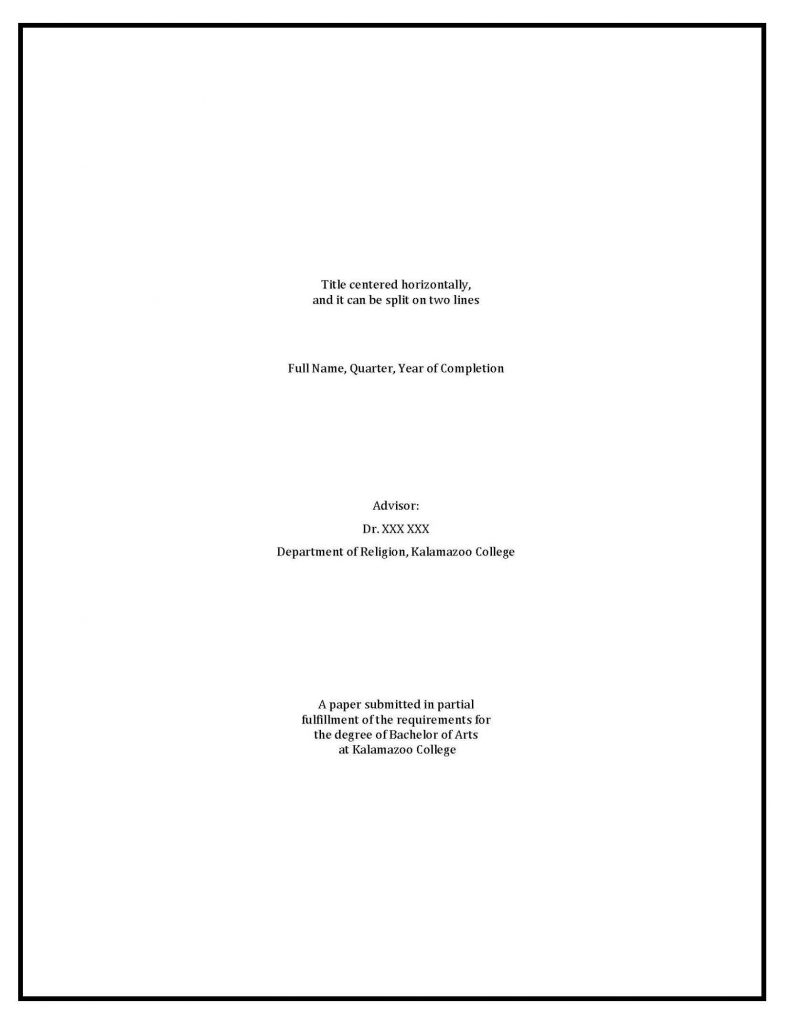
The Title Page should contain these elements, centered horizontally and evenly spaced vertically:
- Title, which can be split on two lines
- Full Name, Quarter, Year of Completion
- “Advisor:”, Advisor name, Advisor department, “Kalamazoo College” (three lines)
- “A paper submitted in partial fulfillment of the requirements for the degree of Bachelor of Arts at Kalamazoo College” (four lines)
Appendix
We have adapted a “Quick Guide” from the Chicago Manual of Style web page for use at Kalamazoo College in the Department of Religion. Students should consult with professors to be sure their citations are accurately formatted. The text and examples given are taken from the Manual of Style web page. We require the footnote and bibliography formats for Senior Individualized Projects (as opposed to the in-text citations). Please familiarize yourself with this guide so you are familiar with the differences between these styles. See Citation Guide for for more details.
The humanities style is preferred by many in literature, history, and the arts. This style presents bibliographic information in notes and, often, a bibliography. It accommodates a variety of sources, including esoteric ones less appropriate to the author-date system.
Online sources analogous to print sources (such as articles published in online journals, magazines, or newspapers) should be cited similarly to their print counterparts but with the addition of a URL. Some publishers or disciplines may also require an access date. For online or other electronic sources not having a direct print counterpart (such as an institutional Web site or a Weblog), give as much information as you can in addition to the URL.
Please note: When using the footnote format, you only need to use the full format for the first instance of each book, article, or source. Each subsequent reference to the same book should use a short or abbreviated version, as in Doniger, Splitting, 76. If you only have one source from an author, you can just use the author’s name, page number.